How Doorstep Rituals Mark Arrival at Home
Doorstep rituals mark arrival with small, repeatable gestures that help separate outside demands from home life and make coming in feel more deliberate.
What can you do at the door to feel that you have arrived home, rather than simply carried the day inside? Doorstep rituals mark arrival through familiar gestures: setting down keys, wiping your shoes, greeting someone, or taking a moment to notice the room before moving on. The point is not to create a perfect routine. It is to make the threshold a clear, personal boundary between outside activity and domestic time.
A doorway already asks for a small change in action: you stop, turn a key, open a door, step over a sill. A ritual gives that change a little meaning. Try a few gestures, keep the ones that fit your household, and let the entrance become a cue for arriving rather than another task to manage.
Let the threshold do one simple job
Choose a single purpose for your arrival ritual. It might help you put work things away, acknowledge the people or animals at home, or notice that you are no longer outside. Keeping the purpose narrow makes the ritual easier to remember. It also prevents a useful cue from turning into an elaborate sequence you feel obliged to complete.
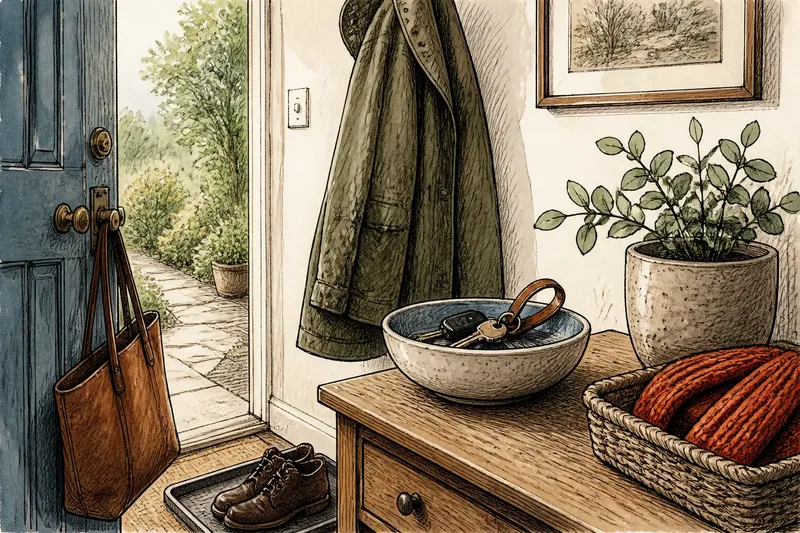
Start by noticing what already happens. Do you reach for the light switch, leave your shoes by the door, or call out a greeting? A ritual can grow from one of those existing actions. For example, you might place your keys in the same bowl and say a quiet “I’m home” as you cross the threshold. The words are optional; the repeated action is what gives the moment its shape.
Pick a gesture that suits the entrance you actually use. In a shared hallway, a silent touch of the doorknob or a deliberate shoe change may be more comfortable than speaking aloud. If your hands are often full, a small pause after putting down your bag may work better than adding another object to carry.
Try a low-pressure week at the door
Use this sequence as a trial, not a challenge. You are looking for a gesture that fits ordinary arrivals, including rushed ones. Keep the ritual short enough to do when you are tired, and treat a missed day as ordinary life rather than a broken streak.
- Notice your usual arrival. Check whether you rush past the entrance, remove your shoes, or reach for your phone. If an existing action already marks the moment, use it as your anchor; otherwise, choose the first natural pause after closing the door.
- Choose one anchor. Check which door action happens consistently, such as turning the key, closing the door, or hanging up a coat. If it is easy to repeat, use it as the signal that you have crossed into home time; if not, choose a more reliable action.
- Add one small gesture. Check whether you can pair the anchor with putting keys in a bowl, taking off shoes, or greeting someone. If the pairing feels simple, keep it; if it adds friction, return to the anchor alone.
- Try it on a hurried arrival. Check whether the shortest version fits when your hands are full or you are tired. If it does, keep that version available; if it feels awkward, drop the added pause and use the anchor only.
- Adapt to a different return. Check whether coming back from an errand calls for the same gesture as returning from work. If the anchor still fits, keep it and adjust the added action; if it does not, use the simplest action available or skip the ritual.
- Consider the people who share the entrance. Check whether your greeting, shoe placement, or belongings affect anyone else. If the arrangement works for them and leaves a clear path, keep it; otherwise, choose a quieter gesture or move your items into your own space.
- Decide what to keep. Check whether the gesture helps you notice that you have arrived and feels natural to repeat. If both are true, keep it; if one is not, simplify it or let it go.
Say you usually come home with a tote bag and a coat, then head straight to your laptop. Imagine choosing “coat on the hook” as your anchor and placing the tote beside it before opening the computer. The concrete steps are to enter, hang the coat, set down the tote, and then decide whether to open the laptop. The observable result is a clear pause in the usual sequence: your coat is put away and your bag is down before work resumes. If the tote blocks the entrance, place it in a clear spot instead; the ritual should not obstruct the path.
Make the entrance support the gesture
A ritual is easier to repeat if its setting does not get in the way. Give frequently used items a sensible home: a key bowl on a stable surface, a hook at a comfortable reach, or a shoe tray near the place you naturally stop. Use what you already have before buying a special object. The object is a reminder, not the ritual itself.
Keep the entrance workable for everyone who uses it. Leave a clear path, avoid placing loose items where someone could trip, and make room for bags or mobility aids as needed. In a shared building, keep personal items inside your own space and follow the building’s rules.
If your front door is not where you enter most often, choose the real threshold: the mudroom, side door, or apartment entry. A ritual tied to the door you rarely use will be easy to forget. Likewise, do not add a candle, scent, or other sensory cue unless it suits the people and pets in your home. A plain gesture can carry the meaning without extra equipment.
Let the ritual change with the kind of arrival
Arrivals vary. You may return with groceries, come in late, or enter while someone else is sleeping. Give yourself a short version for those moments. The same anchor can remain while the rest changes: keys in their place, then a quiet entry; shoes off, then a greeting; door closed, then straight to the kitchen. A flexible ritual is more likely to belong to real life than a fixed sequence with no room for interruptions.
Some days, the most useful choice is not to add a pause. If you need to bring in a delivery before the weather changes or help someone at home, do that first. You can use the familiar anchor afterward, or skip it. The ritual should serve the arrival, not compete with it.
It is not worth trying to make the doorway look like a staged entryway, finding a special phrase that feels profound, or tracking every arrival. Those efforts can draw attention away from the ordinary gesture that already works. Start with what is at hand and make the smallest adjustment that makes crossing the threshold more noticeable.
What should you know about doorstep rituals?
What counts as a doorstep ritual?
It is a small, repeatable action associated with entering home, such as hanging up a coat or greeting a housemate. It becomes a ritual through the attention you give it, not through a particular object or formal wording.
How long should an arrival ritual take?
Keep it brief enough to fit a normal arrival, including a busy one. If it regularly feels like another obligation, remove steps until one simple gesture remains.
Can I have a different ritual for leaving home?
Yes, though it can help to give leaving and arriving distinct cues. You might check that you have your keys before going out, then use a separate action—such as hanging them up—to mark your return.
How can I share an entrance without disrupting others?
Choose a quiet, personal gesture that does not block the path or depend on anyone else’s participation. If the ritual affects shared space, discuss the arrangement with the people who use it.
Keep the useful cue, not a perfect sequence
Settle on one gesture that fits your actual entrance and schedule. You can change it when your household, season, or routine changes; the purpose is simply to recognize the shift from outside activity to being home. Doorstep rituals mark arrival most clearly when they remain modest enough to repeat and flexible enough to miss. A key in its bowl or a coat on its hook can be plenty, especially when you let yourself notice the moment it happens.